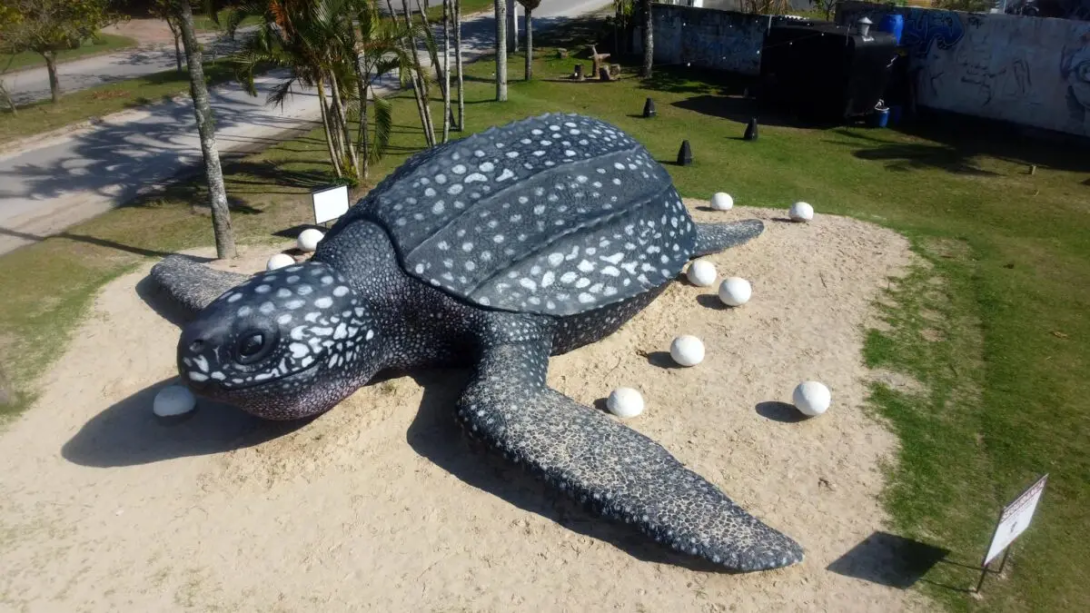
A monumental sculpture of a leatherback sea turtle (Dermochelys coriacea) stands on Avenida Beira-Mar in Pontal do Sul, Pontal do Paraná, Brazil. The sculpture was inaugurated on World Turtle Day, May 23, 2023, as a tribute to marine biodiversity and to the importance of sea turtle conservation on the Paraná coast.
Photo: Prefeitura de Pontal do Paraná / Divulgação.
Source: Folha do Litoral News, 23 May 2023.
The Giant Turtle of Pontal do Sul
More than a tourist landmark, the sculpture gives public visibility to an animal that has a real biological connection with the beaches of Pontal do Paraná.
It represents the leatherback turtle, the largest living sea turtle species in the world, and reminds visitors of the delicate relationship between coastal ecosystems and human activity.
Measuring approximately 10.2 meters in length and 6.5 meters in width, the sculpture was created by Brazilian artist Guilherme Ferreira, known as Índio Artesão.
Commissioned by the Municipality of Pontal do Paraná, the work depicts a leatherback turtle nesting on the beach and connects public art, tourism, local identity and environmental awareness.
What the Sculpture Represents
The turtle is represented in a nesting position, transforming a biological event into a visible symbol of the coastal environment.
Nesting is one of the most vulnerable moments in the life cycle of a sea turtle. A female must leave the ocean, cross the beach and find suitable sand before laying her eggs and returning to the sea.
By placing this scene in a public space, the sculpture creates an opportunity for environmental education and encourages visitors to understand that beaches are not only recreational spaces, but also wildlife habitat.
Leatherback Turtle: Species Profile
Known scientifically as Dermochelys coriacea, the leatherback is the largest living species of sea turtle.
Unlike other sea turtles, its shell is not covered by hard overlapping plates. Instead, it has a flexible, leathery covering with distinctive longitudinal ridges.
Leatherbacks spend much of their lives in oceanic waters and feed mainly on gelatinous organisms such as jellyfish. They are highly migratory animals capable of traveling thousands of kilometers between feeding and reproductive areas.
In Brazil, regular leatherback nesting is concentrated mainly on the northern coast of Espírito Santo. Nesting on the Paraná coast is therefore an uncommon and biologically significant event.
Leatherback Nesting in Pontal do Paraná
According to information released by the Municipality of Pontal do Paraná, leatherback nesting events were recorded in the region in 2007, 2010, 2014 and 2020, with Pontal do Sul accounting for the largest number of reported nests.
During a reproductive season, the same female may return to the beach several times to produce additional nests. A nest can contain approximately 100 eggs.
In December 2020 and January 2021, researchers from the Laboratory of Ecology and Conservation of the Federal University of Paraná — LEC/UFPR monitored leatherback nesting activity in Pontal do Sul.
The researchers isolated the nesting area, collected biological information and monitored the animal, contributing valuable data to the conservation of this rare reproductive occurrence on the Paraná coast.
Sea Turtle Species in Brazil
Five of the world's seven sea turtle species occur in Brazilian waters:
- Green turtle (Chelonia mydas);
- Hawksbill turtle (Eretmochelys imbricata);
- Olive ridley turtle (Lepidochelys olivacea);
- Loggerhead turtle (Caretta caretta);
- Leatherback turtle (Dermochelys coriacea).
Their occurrence and abundance vary greatly along the Brazilian coast. Paraná is particularly important as a monitoring area for marine fauna, and the green turtle is frequently recorded in the region. Reproductive events involving other species are less common and therefore attract significant scientific attention.
A Highly Migratory Species
Leatherback turtles are among the most migratory marine reptiles on Earth. Individuals may travel thousands of kilometers through tropical, subtropical and temperate waters during different stages of their life cycle.
This mobility demonstrates why sea turtle conservation cannot be limited to a single beach or municipality. Protecting these animals requires cooperation across feeding areas, migration routes and nesting beaches.
Main Threats to Sea Turtles
Sea turtles face multiple human-related threats throughout their life cycle.
- Accidental capture and entanglement in fishing gear;
- Marine debris and plastic pollution;
- Boat strikes and other interactions with vessels;
- Coastal habitat alteration and degradation;
- Artificial lighting near nesting beaches;
- Disturbance of nesting females and hatchlings;
- Climate-related changes affecting beaches and marine ecosystems.
How Visitors Can Help
Simple actions can reduce disturbance when sea turtles or nests are present on a beach.
- Keep a respectful distance from turtles and protected nesting areas;
- Never touch, restrain or interfere with a nesting turtle;
- Avoid flashes, strong lights and unnecessary illumination during nighttime nesting activity;
- Remove litter and never leave plastics, fishing line or other waste on the beach;
- Keep domestic animals under control near wildlife and protected nesting areas;
- Report injured, stranded or dead marine animals to the appropriate monitoring or environmental authorities.
Science and Conservation on the Paraná Coast
Sea turtle research and conservation in Brazil involve the Centro TAMAR/ICMBio, research institutions, universities, environmental agencies and conservation organizations.
On the Paraná coast, the Laboratory of Ecology and Conservation — LEC/UFPR plays an important role through the Beach Monitoring Project of the Santos Basin — PMP-BS.
Since 2015, the UFPR team has monitored marine fauna along the Paraná coastline, recording stranded animals, collecting biological and ecological data, rescuing animals when necessary and supporting research on marine biodiversity and health.
This scientific presence gives Pontal do Sul an important connection between environmental education, public awareness and long-term marine research.
Praça da Tartaruga
The giant sculpture was inaugurated on May 23, 2023, on World Turtle Day.
The surrounding public space was subsequently improved with paving, accessibility features, decorative lighting, benches, landscaping and educational elements, becoming known as Praça da Tartaruga.
Today, the square is a recognizable landmark in Pontal do Sul and combines tourism, public space, local identity and environmental interpretation.
A tribute that becomes a commitment: protecting the beach also means protecting the animals that depend on it. The sculpture makes the message visible; conservation depends on what people do next.
About the Tartaruga de Pontal Project
tartarugadepontal.com.br is an independent local initiative focused on the identity and everyday life of Pontal do Sul.
The project connects local information, tourism, culture, environmental awareness, community initiatives and the natural heritage of the region.
The giant turtle has become one of the symbols used to encourage residents and visitors to look more closely at the relationship between Pontal do Sul, the ocean and the wildlife of the Paraná coast.
Sources and Credits
Giant Turtle Sculpture: Guilherme Ferreira — Índio Artesão.
Photo: Prefeitura de Pontal do Paraná / Divulgação.
Information compiled from the Municipality of Pontal do Paraná, Folha do Litoral News, the Federal University of Paraná, LEC/UFPR and Brazilian sea turtle conservation references.
Comentários