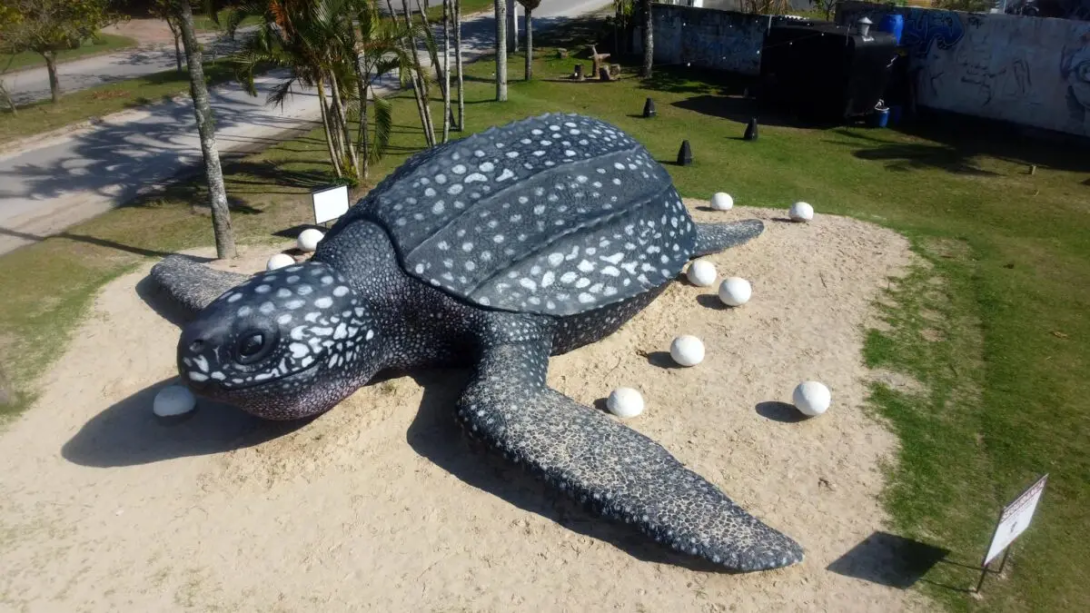
A monumental sculpture of a leatherback sea turtle (Dermochelys coriacea) stands on Avenida Beira-Mar in Pontal do Sul, Paraná, Brazil. Inaugurated on World Turtle Day, May 23, 2023, it honors marine biodiversity and the region’s commitment to conservation.
Photo: Prefeitura de Pontal do Paraná / Divulgação. Source: Folha do Litoral News (23 May 2023).
The Giant Turtle of Pontal do Sul
More than a photo spot, the sculpture is a message carved in concrete: without care for the beach, there will be no next generation. It represents the leatherback turtle, the largest sea turtle in the world, and reminds visitors of the fragile balance between nature and human presence.
Measuring 10.2 meters in length and 6.5 meters in width, the sculpture was created by Brazilian artist Guilherme Ferreira, known as Índio Artesão. Commissioned by the Municipality of Pontal do Paraná, it blends art, environmental awareness, and local identity.
What the Sculpture Represents
The turtle is depicted nesting on the sand, a symbol of strength and renewal. It transforms public space into a platform for education, inviting reflection on the life cycles of marine species and the role of humans in protecting them.
Leatherback Turtle: Species Profile
Known scientifically as Dermochelys coriacea, the leatherback turtle is the largest of all sea turtles. It feeds primarily on jellyfish and gelatinous marine life and is easily recognized by its soft, ridged shell. In Brazil, it is considered threatened, and every nesting event is significant.
Along the coast of Paraná, nesting records have been documented in the summers of 2006/2007, 2009/2010, 2013/2014, and 2020/2021. Females return to specific beaches every two to three years, usually nesting at night. Each nest may contain between 80 and 120 eggs, with hatchlings emerging after approximately 60 days.
Other Sea Turtle Species Found in Paraná
The region is home to five additional species: the green turtle (Chelonia mydas), the hawksbill turtle (Eretmochelys imbricata), the olive ridley turtle (Lepidochelys olivacea), the loggerhead turtle (Caretta caretta), and the leatherback itself. Each species has distinct shell patterns, head scales, and dietary habits, ranging from herbivorous to omnivorous.
Where They Come From
Sea turtles that reach Paraná travel thousands of kilometers across the Atlantic. Migration routes connect the region to the Caribbean, West Africa, and South American coasts. Some individuals originate from islands like Trindade, Ascensão, and Bioko, highlighting the global scale of marine connectivity.
Local Threats to Sea Turtles
Despite their resilience, sea turtles face numerous threats along the coast. These include marine pollution, entanglement in fishing gear, injuries from boat collisions, and habitat loss. Human activities such as littering, artificial lighting, and unleashed dogs can disrupt nesting and harm hatchlings.
Beach Care Guidelines
Visitors are encouraged to respect nesting zones and avoid using flash photography or bright lights at night. Plastic waste should be strictly avoided, as turtles often mistake it for food. Dogs must be kept on a leash, and any injured animals should be reported to local environmental authorities.
Who Protects Them
In Brazil, sea turtle conservation is led by Projeto TAMAR and ICMBio, with decades of research and public engagement. On the Paraná coast, the Laboratory of Ecology and Conservation (LEC) at UFPR monitors nesting activity and educates the public. Municipal programs support signage, lighting control, and shoreline care.
About Turtle Square
The sculpture is part of Praça da Tartaruga, inaugurated on May 23, 2023, in celebration of World Turtle Day. It stands as a tribute to marine biodiversity and reinforces the community’s collective commitment to ocean conservation. The square is a landmark of pride for Pontal do Paraná.
A tribute that becomes a commitment: keep the beach clean, keep the nights dark, and keep the way open for the next turtle to arrive. The statue points the way — the rest depends on us.
About the Project “Tartaruga de Pontal”
tartarugadepontal.com.br is an independent local initiative that promotes the identity of Pontal do Sul through culture, environmental awareness, and community tourism. It highlights regional art, conservation efforts, local businesses, and educational programs focused on the coastal ecosystem. The platform serves as an open channel for residents, visitors, and schools to discover, collaborate, and protect what makes this region unique.
Credits: Giant Turtle Sculpture — Índio Artesão. Photos: use your own or authorized images. Educational content compiled from environmental agencies, universities, and official signage at the site.
Comentários